
Between 2018 and 2024, neo-banks grew their share of the UK banking market from 16% to 50%1. The incumbents that lost ground had strong brands, loyal customers, and decades of trust. What they didn’t have was frictionless resolution. Customers didn’t leave for better rates. Customers left for time back, faster fixes, instant answers, problems solved before they became problems.
The institutions that moved earliest retained the most. Travel is at the same inflection point. And the trigger is AI.
Price will still matter. It will always matter. But in the AI era, price alone will not be enough to win, or keep, the customer. As discovery and booking become faster and easier, competitive advantage shifts downstream, to what happens after the booking.
Servicing is becoming the next battleground for acquisition, retention, margin, and trust. Most of the industry is not equipped to compete there.
That gap has a name — the Execution Gap
1 RFI Global’s UK banking survey, published February 2025
AI is changing how travel is won.
Not by replacing agencies — but by shifting where competition happens.
For years, travel has competed at the front of the funnel: search position, price, conversion.
Now, as AI makes discovery faster and easier, that advantage is being commoditised.
The battleground is moving downstream.
To what happens after the booking.
Price isn’t going away. It still drives acquisition.
But in the AI era, it’s no longer enough.
Because for the first time:
These aren’t satisfaction metrics.
They’re retention signals.
AI isn’t just changing search. It’s changing what gets considered.
Travelers can now ask:
And get an answer — instantly.
At the same time, AI models are already incorporating:
You can’t bid your way into those signals. They’re earned.
Travel has automated ~40% of servicing.
The remaining 60% — the most complex, highest-stakes scenarios — still rely on manual processes.
That 60%:
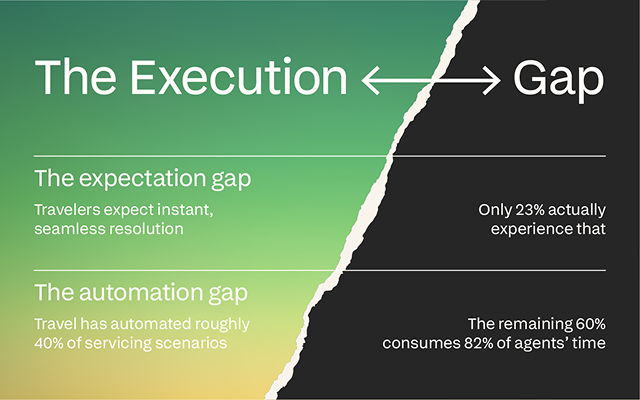
This is the Execution Gap:
For OTAs
Servicing is no longer just retention — it’s acquisition.
For TMCs
White-glove service has to scale.
But they expect:
This isn’t a feature.
It’s the new baseline.
AI is not eliminating OTAs or TMCs.
But it is exposing where advantage actually lives.
The companies that close the Execution Gap:
In the AI era, execution is the brand.

Travelers arrive at the moment of disruption carrying a benchmark that has nothing to do with travel. They’ve spent a decade experiencing frictionless resolution in banking, retail, and subscription services. They know what instant looks like. They know what good feels like. And that expectation travels with them into every cancellation, every exchange, every delay.
67% of travelers now use AI tools as part of their travel planning. Among them, 65% use AI to research destinations and 58% to compare flights — and 67% say it has a significant or primary influence on their final booking decision.2
Where should I go in April for good weather?
What are the best flight options under £500?
Which of these providers is most reliable if something goes wrong?
All within the same flow. No tab-switching. No manual research. No friction.
And that expectation doesn’t stop at discovery. If finding the right flight takes seconds, travelers increasingly expect resolving a problem to work the same way.
2 Wenrix Consumer Research, 2026
At the same time, AI is changing what gets surfaced, not by removing price as a factor, but by expanding what is considered alongside it.
In the AI era, reliability and servicing quality are becoming visible, and measurable, at the point of discovery.
This is happening for three reasons:
Tools already pull from sources like reviews, ratings, and reliability data to inform what they surface. In live testing of AI trip planners, results are not just ranked on price or convenience, but on customer satisfaction, reliability, and disruption handling. You couldn’t bid your way into those signals.
They’re earned.
In traditional search, evaluating service meant opening multiple tabs, checking Trustpilot, reading reviews, and forming your own view. With AI, that friction disappears. A traveler can simply ask:
Be honest—who’s the least painful to deal with if my trip gets messed up by weather or something?
and receive a synthesised answer immediately.
Top Agencies for “Hand-Holding”
Trailfinders: Voted the most trusted UK travel brand for 2026. They provide 24/7 human support and take full responsibility for rebooking you during “Force Majeure” events (like the current Middle East crisis).
Flight Centre: Known for their “Captain’s Package” which offers dedicated assistance during disruptions, often bypassing long airline phone queues.
Travelers don’t just see a rating, they get context. Instead of reading dozens of reviews, they can ask: “How well does this provider handle cancellations?” or “Do they process refunds quickly?” and get a direct, summarised response.
This shift toward recommendation-driven discovery isn’t entirely new. Platforms like Skyscanner have already introduced “Recommended Provider” badges based on price accuracy, availability, booking reliability, and post-booking support quality. One leading global OTA saw a 20% increase in conversion when recognised as a recommended provider.
What brands are surfaced in the AI era will increasingly be driven by reputation — and reputation is built at the back of the funnel.

The expectation has been set. But travel’s infrastructure hasn’t kept up.
Two gaps sit inside the Execution Gap:
Travelers expect instant, seamless resolution, in fact 45% say their preferred way to resolve a disruption is to be notified automatically, before they have to do anything. But only 23% actually experienced that. 13% gave up and went direct to the airline.
Travel has automated roughly 40% of servicing scenarios — simple cancellations, clean refunds, basic exchanges. The remaining 60% — the complex, rule-heavy edge cases that define the traveler experience when things go wrong — still depends heavily on manual intervention. And that 60% consumes 82% of agents’ time.
Together, they create a problem that compounds. Cost-to-serve stays elevated. Margin leaks during disruption. Retention weakens every time resolution requires effort it shouldn’t. And poor servicing feeds directly into how you are discovered next.
Ultimately, the part of the experience that matters most is the part the industry is least equipped to deliver.

Brand-led OTAs invested in trust and the full customer relationship. Conversion-led OTAs optimised acquisition — and largely ignored what happened after booking. For years, it didn’t matter. Now it does.
Price still wins the booking. It always will. But price alone no longer defends the relationship, or wins it in the first place. In the AI era, servicing is the second half of the value equation.
This shift applies across the entire customer base. Price and servicing now sit side by side, for once-a-year and frequent travelers alike — because both are visible, and both are easy to evaluate in the AI-driven journey.
The difference is economic. The impact concentrates with frequent travelers, where lifetime value is built, and where servicing, alongside price, determines whether they come back.
Flexibility is part of the same equation. Flexible fares are servicing products dressed as booking features. When they work, they reduce risk, build trust, and justify a premium. When they don’t, they do the opposite.
There is a compounding effect:
And the stakes are higher than retention alone. Airlines have structural advantages — direct customer relationships, control over pricing and inventory. For years, the assumption was that distribution shifts or pricing advantages would gradually push travelers toward booking direct. But that logic only holds if the experience is equivalent. It isn’t.
The OTA advantage has always been breadth — multi-carrier options, the connected trip, comparison, convenience. In the AI era, that advantage only holds if it is matched by execution. Because when something goes wrong, the question isn’t: “Who sold me this ticket?” It’s: “Who can fix this fastest and the easiest?”
In an AI-mediated world, you’ll be discovered by algorithm. But you won’t win and retain on price alone. You’ll be remembered — or forgotten — by how you execute when things go wrong.

49% of all travelers are comfortable with AI handling automated rebooking during a disruption. Among frequent corporate travelers that rises to 76%. Only 7% say they would never want anything handled automatically.
The question isn’t whether travelers will accept AI in servicing. It’s whether agencies will build it in a way that meets their expectations.
Those expectations are clear:
want instant notification with a clear summary of what has changed
want a simple one-tap option to accept, modify, or reject the rebooking
want confidence that downstream impacts — hotel, transfers, connecting bookings — have been checked and handled
Among corporate travelers those numbers are higher across every dimension — driven by the fact this isn’t a holiday they’ve been waiting for months, and every minute spent on hold is cost to them finishing on time, and cost to their business.
This isn’t a feature set. It’s a new baseline.
Travelers don’t want AI to assist. They want it to act — proactively, accurately, and with full visibility of what has been done and why.
As AI becomes embedded in how trips are planned, the expectation that it can also resolve the problem — not just find the flight — will follow.

For OTAs, it means enabling seamless self-service resolution, with intelligent escalation to a human agent when absolutely needed.
For TMCs, it means scaling white-glove service through automation, freeing agents to focus where they add value.
The experience changes fundamentally.
A disruption occurs. The traveler is notified immediately. Options are pre-calculated, fare rules applied, and the best alternatives surfaced instantly. Resolution happens seamlessly in one interaction.
A complex refund or exchange is requested. The traveler can manage it themselves in 2 clicks.
No queues. No fragmentation. No unnecessary effort. Just resolution.

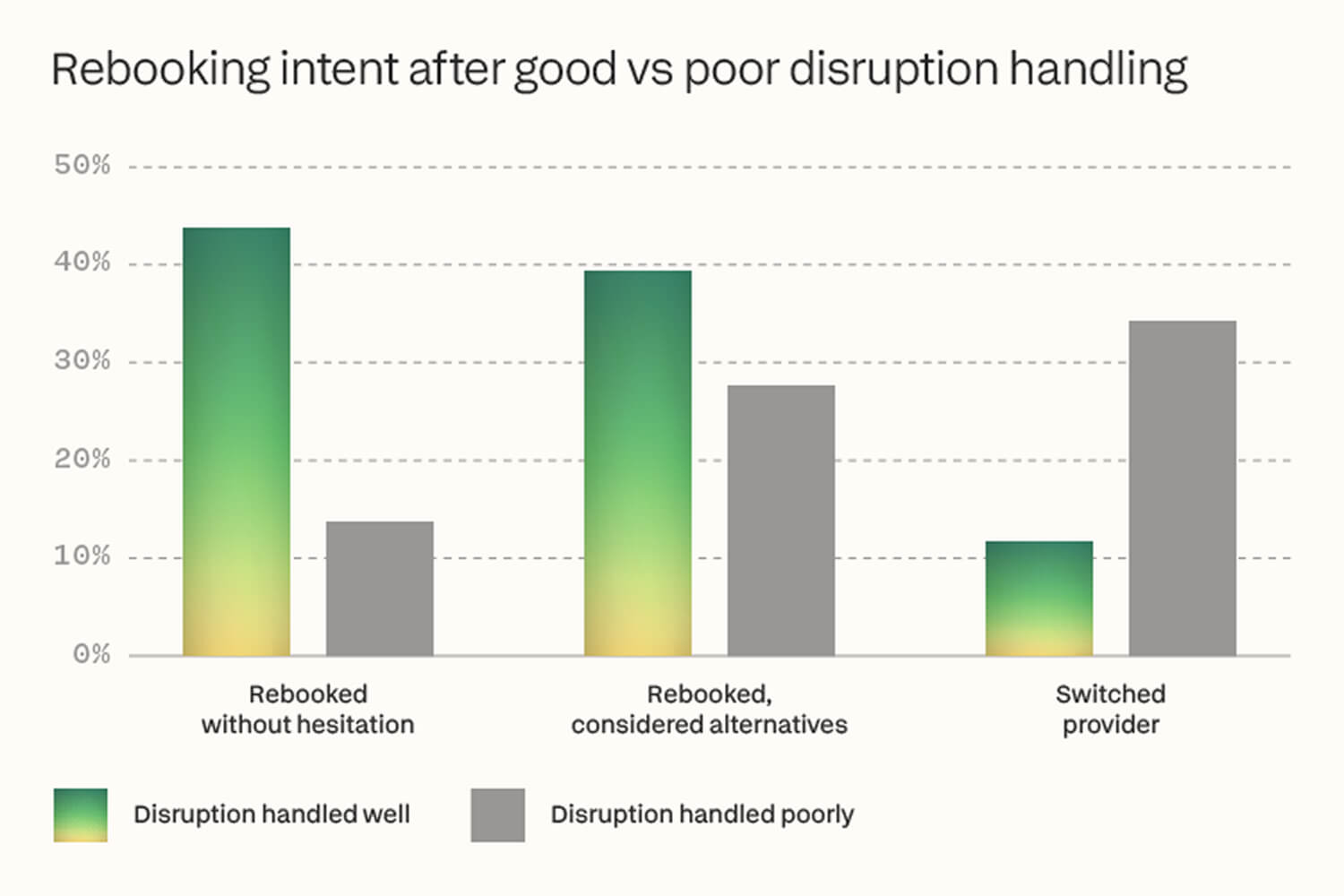
Among frequent travelers, a well-handled disruption makes them 64% more likely to rebook with the same platform than a poorly handled one.
49% of travelers choose a platform rated for fast disruption handling over the cheapest option — even at a 5% price premium.
84% of all travelers rate flexibility as important or extremely important when choosing a platform.
Top-rated providers see XX% higher recommendation or conversion rates.
Together, these shift servicing from operational cost to commercial advantage.

The battleground has moved. It is no longer just about who wins the booking. It is about who earns the next one.
The brands that win will be the ones travelers choose — not the ones they land on. That choice is earned in the moments that matter.
Price will always matter. But in a world where discovery is mediated by AI, it is no longer enough.
Execution is the differentiator. And the companies that close the Execution Gap first will build an advantage that is difficult — and slow — for others to replicate.
The institutions that moved first in banking retained the most. The agencies that move first here will too.
Wenrix Consumer Research 2026 Methodology:
Research was undertaken with Toluna Corporate Insights, to investigate traveler sentiment and behavior with AI. We surveyed over 2,000 people from different demographic, all of whom have flown for leisure or work within the last 12 months, across 4 countries including the UK, USA, Singapore and United Arab Emirates.